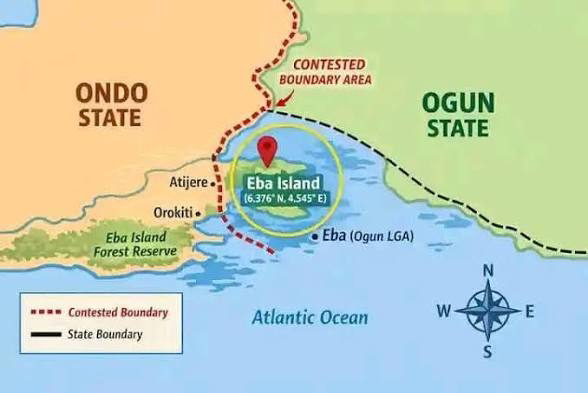
The ownership controversy surrounding the oil-bearing Eba Island has continued to generate tension between Ogun and Ondo States, with both states laying claim to the territory and its potential economic benefits.
The dispute, which gained national attention following moves to commence commercial oil exploration in the area, has triggered legal, political, and traditional arguments over the true location and ownership of the island.
Ogun’s Position: Federal Actions Strengthen Its Claim
Ogun State has maintained that Eba Island falls within Ogun Waterside Local Government Area, arguing that existing maps, administrative records, and government processes support its position.
The state’s claim received attention after the Federal Government approved oil exploration activities in the area. The Nigerian National Petroleum Company Limited (NNPCL), alongside the Nigerian Upstream Petroleum Regulatory Commission (NUPRC) and security agencies, inspected the site as preparations for drilling progressed.
Supporters of Ogun’s claim have pointed to geographical coordinates, electoral structures, and historical boundary arrangements, insisting that there has been no official transfer of the territory to Ondo State.
Ondo’s Argument: History and Administration
Ondo State has rejected Ogun’s claim, insisting that Eba Island belongs to the Ilaje axis of Ondo State.
The Ondo Government has argued that historical records and decades of administration place the area under Atijere in Ilaje Local Government Area. Officials have cited the existence of traditional and administrative structures dating back decades as evidence of Ondo’s connection to the territory.
Traditional rulers and stakeholders in Ilaje have also opposed Ogun’s position, calling for recognition of what they describe as their historical ownership of the area.
National Assembly Steps In
The controversy has now moved beyond state-level arguments, with the House of Representatives intervening.
The House ordered an investigation into the territorial status of Eba Island and directed relevant committees to work with the National Boundary Commission to examine maps, documents, and other evidence surrounding the dispute.
The National Boundary Commission is expected to play a key role because interstate boundary matters fall within its mandate, while courts may ultimately determine the matter if a legal challenge arises.
Who Is Likely To Win?
For now, Ogun appears to have an advantage in terms of ongoing federal activity, as oil exploration preparations have been linked to the Ogun Waterside location.
However, Ondo’s historical documents and administrative claims could become significant in any formal boundary determination or court process.
Observers believe the final outcome will depend less on public statements and more on official maps, gazettes, historical records, and legal interpretation.
A negotiated settlement involving both states and the Federal Government also remains possible, especially to prevent disruption of oil operations and maintain peace in the coastal communities.